← Back to Learn
Anatomy

How a sump pump actually works.

Every part, what it does, and why specialists look at this differently than a plumber who installs a pump between a water heater and a garbage disposal.

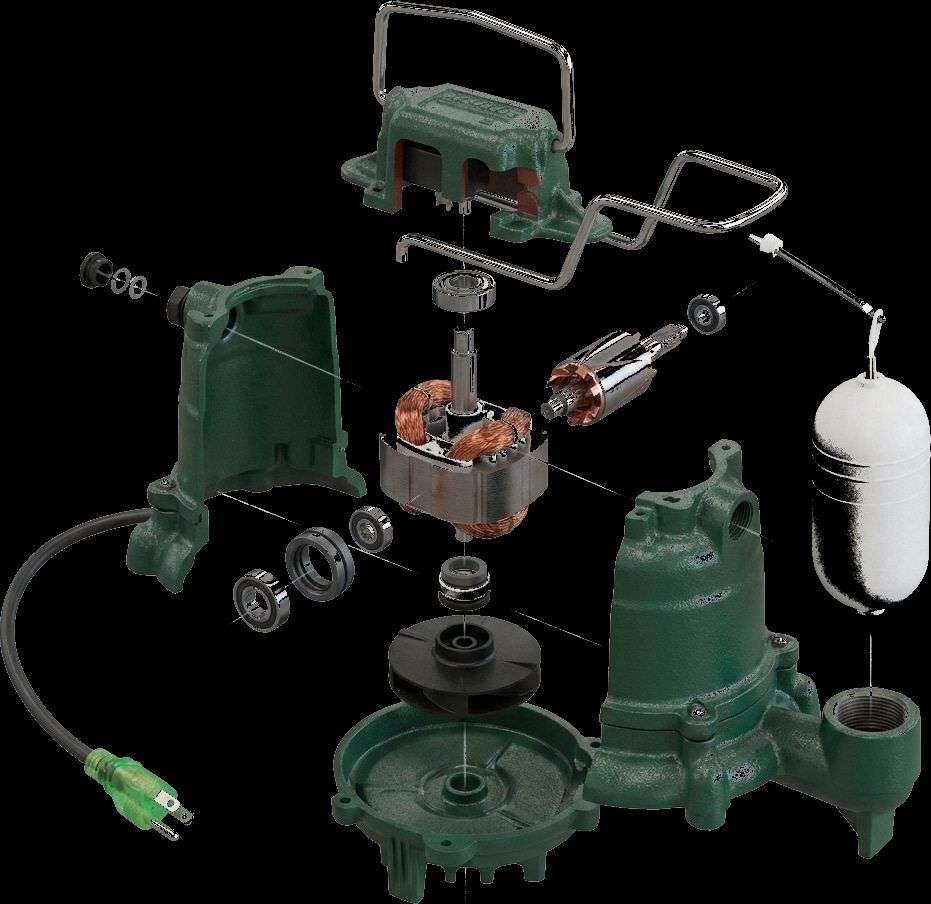
Exploded view of a Zoeller sump pump showing its motor cap, handle, housing, stator, rotor, bearings, impeller, volute, float switch, and power cord

A Zoeller pump, taken apart — the same ten things in every quality sump pump

Why understanding the parts matters.

You don't need to be able to build a sump pump to own one. But when something goes wrong — and something will eventually go wrong — the difference between a $200 fix and a $20,000 flood is whether the person diagnosing it knows which part is failing and why.

The parts below are the same parts in every quality sump pump. Learn them once and you'll never be guessed-at by a generalist plumber again.

01
Part 1

Motor cap

What it does

The motor cap closes the top of the motor housing. It carries the handle, seals the motor from basin humidity, and keeps splash water from reaching the stator windings.

What fails

Corrosion at the seal. Over years, minerals in basin water build up around the gasket and compromise the seal. Once that's gone, humid air reaches the motor.

How we test it

On every K-Guard visit we check the cap for surface corrosion, verify the gasket still holds its profile, and tighten the handle bolts. Cheap to do. Expensive to skip.

02
Part 2

Carry handle

What it does

The handle is how the pump comes out of the pit for service. Sounds boring. It's not — a bent handle often means the pump has been yanked from a stuck position, which usually means the discharge line was frozen or clogged.

What fails

Bending, rust at the attachment points, or loose mounting bolts. These aren't pump failures but they tell us something is wrong upstream.

How we test it

Visual inspection and a bolt check. If a handle has been stressed, we note it and ask what happened last winter.

03
Part 3

Motor housing

What it does

The housing encloses the motor and carries its heat into the surrounding water. Cast iron, because iron is both stronger than plastic and a better heat sink — pumps run cooler and last years longer.

What fails

Surface rust is cosmetic. Internal cracking from freeze-thaw cycles is catastrophic. If the motor housing fractures, water reaches the stator and the pump is done.

How we test it

We look for any hairline cracks, check that mounting feet are true, and note rust severity against prior visits. Trend matters more than a single reading.

04
Part 4

Stator + rotor

What it does

The stator generates a magnetic field. The rotor spins inside it at 3,450 RPM. That rotation is what moves water — everything else in the pump exists to support this one job.

What fails

Burnt windings from overheating. Usually caused by a pump running too often (upstream drainage issue) or running dry (float switch stuck). Either way, the motor is toast.

How we test it

Amp draw under load. If the motor is pulling more amps than spec, it's working harder than it should — a preventable failure we can flag before the windings go.

05
Part 5

Impeller

What it does

The impeller is the fan-shaped piece that pushes water. The rotor spins it; its curved vanes fling water outward into the volute, then up the discharge pipe.

What fails

Debris. Gravel, sediment, a small tool dropped into the basin — anything solid can chip a vane or jam the impeller entirely. Plastic impellers crack. Cast iron survive.

How we test it

Visual inspection with the pump pulled. We look for vane chips, mineral buildup, and any sign of foreign debris in the chamber.

06
Part 6

Volute + base

What it does

The volute is the chamber around the impeller and the base that anchors the pump in the basin. Its internal shape determines how efficiently water gets from the impeller into the discharge outlet.

What fails

Clogging at the inlet screen. Also cracking at the base from freeze-thaw cycles on pumps sized too small for the basin volume.

How we test it

We clean the inlet screen, inspect the internal volute for mineral scale, and confirm the base sits flat in the basin. A pump that rocks is a pump that vibrates itself apart.

07
Part 7

Float switch

What it does

The float rises with the water level in the basin. At a preset height it trips the switch that powers the motor. When the water drops, the float drops, and the pump shuts off. Deceptively simple. Disproportionately important.

What fails

Mechanical binding from debris, tether tangles, or corroded switch contacts. Most pump "failures" turn out to be float failures — the pump itself is fine, but it never got the signal to run.

How we test it

Manual lift test on every visit. We pour water or lift the float by hand, confirm the pump cycles on and off at the right levels, and check the switch contacts for corrosion.

08
Part 8

Power cord

What it does

120V power from a dedicated GFCI outlet to the motor. The plug is grounded. That last detail matters — sump pumps live in wet environments, and GFCI protection is what keeps them from becoming a shock hazard.

What fails

Cord pinching behind the pump. Water intrusion at the plug end. GFCI outlets tripping from a borderline ground fault you can't see.

How we test it

Cord inspection from pump to outlet. GFCI reset test. Voltage check at the plug under load. We also verify the outlet is on its own circuit — sharing a circuit is how basements flood during storms when something else trips the breaker.

What a specialist notices that a plumber doesn't.

A generalist plumber looks at a sump pump and sees a pump. A specialist looks at the same pump and sees: the amp draw trending up over 18 months, a float tether starting to bind against the basin wall, a discharge line that freezes at the same point every February, and a volute with mineral scale that's narrowing the flow path.

None of those are visible at a glance. All of them are the difference between a pump that quietly does its job for a decade and one that fails in the middle of the worst storm of the year.

This is why we only do sump pumps. After enough pits, you stop guessing. You start recognizing the small signals that this float is about to stick, or that this check valve is going to fail before the next storm. It takes volume to see those.

Protect your basement before the next storm.

Free assessment. Fixed pricing. No obligation.

100% satisfaction guarantee on every installation.